Wednesday, June 25, 2014

Tuesday in Haiti: A Time to Give & a Time NOT to Give


Many of you are familiar with the story of the young man who walked down on the beach when he saw an old man throwing starfish into the ocean.  He walked up to the old man and asked him what he was doing.  The old man’s reply was that starfish had been washed up on the beach by the tide, and he was throwing them back into the water.  The young man looked down the beach to see hundreds of starfish.  He said that it was impossible to save all of the starfish; there were so many, and he couldn’t possibly make a difference.  The old man bent down, picked up a starfish, and tossed it in the water saying, “Made a difference to that one!”

We can be concerned that there are so many people in Haiti who need assistance.  This can become overwhelming, but the key to making a difference is not in giant leaps but in small steps.  At reflection time tonight, we discussed that the key to helping the people of the Grand-Bois area is understanding what the people need.  It is not a simple fix but it is taking the slow but sure route through micro-financing and education.  It’s not hand outs but hand ups.  It’s the hard route but one that is the most sustainable.

Today was teaching day #2, and we asked each teacher how far they had traveled.  Three said they had to walk six hours to attend the teaching training and two others came five hours.  Today’s lessons were, in Janet’s words, magical.  She said she is not a crier but when she watched the teachers share picture book lessons with the rest of the class, it made her want to cry.  In fact, their presentations brought tears to our eyes.  As Alfred, our interpreter, stated, “I have a bottle of joy jumping in my heart.”  He was so proud of the teachers and the progress they are showing towards improving their teaching skills.

Mary, Janet, and I hiked over to a school house in the area.   Janet was excited to see they now had a cement floor.  It is startling the difference between schools here in Haiti and in the United States – chalkboards only, benches, and planks for tables.  No technology and no classroom libraries. 

A group spent today hiking to the Dominican Republic.  The “short” trek turned into one of over six hours.  As Scott, our leader, said, “The difference between an adventure and an ordeal is attitude!”  They all had the right attitude even though they returned with tired feet, headaches, and sweat drenched shirts.  Once again it was the Haitians gracefully sliding by while carrying loads of sticks and jugs of water that kept this adventurous crew moving forward. Along the way home, Sam stopped to join a group of young men with flat-ended sticks beating black beans still in their pods on a tarp.  Their "bean dance" was coaxing the beans out of the pods, and Sam brought out laughter as together they did the work.  We all laugh in the same language.  

Gary told of yet another visit to a bakery that is receiving micro-financing from ServeHAITI.  He said that the owner had brought a propane powered oven over three hours on the back of a donkey from the Dominican Republic for his business because he wanted to preserve the trees in Haiti and not burn them in the traditional oven.  The oven had a broken door, and the bread the baker was making kept burning.  It was hurting his business, and Abraham, our interpreter, decided he would work on it.  He laid down on his back and examined the door hinges and was able to solve the problem.  It was a simple fix.  Sometimes it’s the smallest things that make the biggest difference.

We spent time tonight talking about knowing the right time to give and the right time NOT to give.  It is an important balance we all must learn if we are going to make a difference for the Grand-Bois area.  As ServeHAITI states, we must focus on dignity not dependence.  That is what I love about this organization.  Providing dignity through relationship-building takes time and tiny steps, but this process is sustainable.  It is making a difference in the lives of many in this area.  We cannot help everyone, but we are making a difference to those we encounter along our journey in Grand-Bois.  I am honored to be a part of ServeHAITI!


Tuesday, June 24, 2014

Monday in Haiti: Haitian Time


Back in the States, our days are determined by time – the job, the appointment, the activity, the deadline.  We rush from this to that, pushed along by calendars and commitments.  Things are different here in Haiti.  They live by Haitian time and when a Haitian says we will be there in four hours it could mean nine.  It isn’t the calendar that determines destination - it’s the heaviness of the load you carry, the speed of the burro, the ruts in the road.  Haitian time.

Today was Teaching day!  The bags were unpacked, supplies set out, folders ready, posters hung, lessons written, and we were more than ready to work with 20 elementary teachers for three days.   Mary and Janet explained that we would have to be flexible since Haitian time is not the same as U.S. time – meaning the day was to start with a Geometry lesson given by a principal from the local high school.  He arrived over an hour late so we began our lesson by reviewing what a model lesson consists of along with activities using geoboards.  When he arrived, we did not realize he would teach for over 3 hours including pi and lines of infinity – well above the heads of many of our teachers.  To teach elementary school in Grand-Bois does not require any degree, not even a high school diploma is required.  You simply go in and say you want to teach and hope to get hired. That is why the teacher training provided by ServeHAITI is so critical to the future of education in this country.  Our teaching these next few days will focus on content but also strategies to make lessons come alive for students.  Many returning teachers said they loved the group work last year.  As one teacher stated, “It makes more pleasure when you share ideas.”

What struck us when we began were the shoes of the teachers.  Many had come a long way and from the wear and dust on their shoes; many had walked great distances to attend this training – with a belief that through this training they will improve as teachers.  Tonight there are several who are staying here in the clinic – some on benches downstairs while a few lucky ones have beds upon which to lay their heads.  The distance is too great to assure they will be back here on time for school.  While the World Cup was showing on a newly purchased TV in the clinic, many were studying materials they received today and writing model lesson plans for tomorrow’s class.

I know that when you work with someone of a different language and culture, the strategy is NOT to speak “loud and slow” although that is what I found myself doing today as we worked with these teachers.  Of those present, 15 were back after receiving training last year.  They said they returned to learn even more.  One teacher stated that last year the lessons were “fantastic” and this year he came to learn “perfection.” 

There were other things going on around the clinic besides the teacher training.  India was helping the pharmacist sort out medicine.  Robert, Sam, and Brian fixed toilets and faucets along with painting chalkboards for classrooms.  Gary and Chris visited another bakery that had received micro-financing from ServeHAITI.  The business has grown and now has two ovens – the first financed by this organization and the second purchased with profits from their growing business.  The kneader pictured above has helped them produce a bread that many walk several miles to purchase.  They run their stoves with propane gas so they are not cutting down trees to support the fire of their cooking.  Gary had some time along the way to deliver dresses made by families back home – no deadlines just Haitian time used to build relationships and add encouragement to the people of the Grand-Bois area.

One of the things we unpacked from the suitcases were endless supplies of black beads, cloth strips, and crucifixes.  These items are purchased on a regular basis by a local priest in Iowa.  Through generous donations, he also provides wages for workers based on number of rosary beads constructed.  He then donates the rosary beads to Catholic soldiers, serving around the world, a special outreach that helps to employ the people of Grand-Bois allowing an opportunity for many to feed their families.  The dream is that one day there will be a rosary bead factory that provides room to work rather than the narrow alleyway of the clinic.

We continue to be amazed by the resilience of the Haitian people who will not allow rough terrain or lack of resources to keep them from working to achieve their dreams.  It is said, “Teaching is not filling a bucket but kindling a fire.”  ServeHAITI is attempting to kindle many fires here in Haiti.  They are not filling a bucket but instead by offering encouragement, guidance for developing a finance plan, and some monetary resources with a guarantee to repay, those being served will take that kindling, that vision, that spark of a dream and bring forth its fire to improve themselves and their community.


Tonight we celebrated the 2nd anniversary of Robert and India with a cake made by the local bakery.  It was a joy to reflect on the veranda about our day and the bigger picture of our lives.  We sat with no cell phones to answer, emails to read, deadlines to meet.  Instead, we filled ourselves with the contentment of learning about each other, sharing our insights, and pausing for a special moment we are coming to know fondly as Haitian time.


Monday, June 23, 2014

Sunday in Haiti: More Rocks, More Roads, & More Relationships


Our day began with a trek down the mountainside to church.  The walk was amazing as we stumbled and slid over rocks and ruts and gullies while Haitians in high heels giggled past us.  The beauty of the landscape was appreciated even though the tough terrain made us doubly aware of the ease of life back home.  Haitians rode by us on burros sitting astride wooden saddles.  Some sped by while carrying logs or bags of beans on their heads.  Still others in their Sunday best with heeled shoes gracefully slid past us, the rocks and ruts a natural part of their movement.  Church was filled with beautiful singing, happy people, and a special spirit reflected by the people of this land. 


The  Market Place
After church, we walked to the market.  As Chris stated, it was a place where entrepreneurs laid blankets on a rocky, dried riverbed, selling varied items from tennis shoes to matches to tobacco to mangos.  It is a land of people willing to travel over difficult terrain to deliver whatever they have to sell.  It is a testament to the spirit of these people and their desire to survive in spite of difficulties faced. 


Chantelle and her kneading machine
Some traveled with Gary to visit Chantelle, the first to receive a low interest loan from ServeHAITI to maintain her family’s bakery after an unfortunate fall from a tree leaving her father in need of extra care.  After developing a finance plan, she was able to purchase a dough kneader.  She noticed that people did not like the texture of her bread and a kneader enables her to create a smoother dough.  She is operating her business in spite of losing her mother, her father, and most recently her horse that helped to transport flour from the Dominican Republic to her bakery.  Chantelle is defining dignity for her family and for the Grand-Bois community with her strong spirit and devotion to hard work. 

While the teachers were working on unpacking suitcases and preparing for the teacher training on Monday, several others traveled to a youth group meeting where over 200 were present.  The meeting was organized by some of the youth of the area to honor ServeHAITI.  They sang a song they wrote about the importance of organizing and having dreams.  Alfred said it was encouraging to see the youth take on leadership and not be afraid to dream.  They showed a passion that displays hope in their future.  ServeHAITI is providing a model of providing assistance to those who are willing to develop a plan and provide sweat equity towards implementing their ideas.  The youth are interested in learning computer skills, having a cyber café, and learning so they can improve their lives.  The internet can open many doors through digital  books, online classes, and also broaden their view of the world.  All present were encouraged by their genuine desire to work towards achieving their dreams.  As one interpreter said, “The light is sparkling!”

Tilapia ponds
The beginning of a vision
Tonight at reflection time, Brian made the statement, “I saw evidence today of Haitians recapturing the blessing of this area.”   Dr. Leo who runs the clinic for ServeHAITI in the Grand-Bois area is a true visionary.  He inspires the people to work hard.  He is working on building a center based on his vision of a stage, cinema, cyber café, dance club, and hotel.  He has ponds behind the building stocked with tilapia.  He showed us his coffee bean trees that require a canopy of other trees around them in order to survive.  Much like the people of the Grand-Bois area need some assistance to thrive, ServeHAITI is supplying the canopy of encouragement many need to allow their dreams to grow.

Alfred, our interpreter, made the profound statement that capitalizing on opportunities is a way to “win your life.”   The Haitian roads may be rocky but organizations like ServeHAITI allow others to use those stumbling stones as stepping stones to a better future.

Sunday, June 22, 2014

Haiti Adventure – Saturday, June 21, 2014

At Friday night’s reflection time as we shared what we hoped to get out of our visit to Haiti, Brian shared the line from the movie Lord of the Rings – where Bilbo Baggins states as he enters the boat, “I am quite ready for another adventure.”  We found ourselves fondly referring to this statement as we trekked today from Port Au Prince to Grand Bois.  Our journey was really quite an adventure with several stops along the way.


Today’s focus would be examining the problem communities face with having access to clean drinking water. We do know there are still 100,000 Haitians living in tents since their disastrous earthquake in 2010.  The earthquake and its aftermath were not the only thing that created a serious issue with safe drinking water for this country.  Lack of quality roads for travel adds to the lack of technology and education that would lead to advancements.  One of the beliefs of ServeHAITI is that one who travels  here, should through outreach get into the community and develop an understanding of the Haitian culture.Many of us felt we had preconceived notions about this land of contrasts, but our eyes were opened as we entered their world today to hear their stories.  We stopped to observe a group working diligently to drill a well for ServeHAITI.  It was a community event as people gathered round to watch the workers continue seeking water, a search that has gone on for several days.  Some of us stood up on the roadside, not taking the steep climb down, and spent time contemplating how to solve the problem of hauling the water up to a more well-traveled road, considering a pulley system or a water tower.  In third world countries, women spend 1/4 of their lives gathering water and many people travel 6 hours one way to gather decent drinking water for their families so access to water is a major issue.


Our next stop was an orphanage supported by ServeHAITI.  The children were spending nap time giggling and doing gymnastics with our workers.  A group of girls were outside doing their hair, and Gary delivered bracelets to them made by several young girls in DeWitt, Iowa.  Our hearts were touched as we considered the future that awaits this group of children.  Many of us asked ourselves, “How can we take these children with us?”


Next stop?  A new school building whose construction is a partnership with ServeHAITI.  The community constructed the building but now ServeHAITI will assist with putting in a floor to adequately prepare it for classes.  There were many gathered here; they knew we were coming.  The group gathered in the school house and continued to discuss other needs of their community.  They walked us back behind the school house to show us their current water source – a mud hole where animals also drink.  A member of our group Gary came forward to state that his church, St. Joe’s in DeWitt, Iowa, would support the building of a well on the spot where we were standing.  The people began to call him, “White Lion,” and handshakes were extended with a commitment to solidarity between the community and ServeHAITI.


Just when we thought we would not stop again until we reached the Clinic in Grand-Bois, we were greeted by over 200 people bearing bouquets of flowers and a sign welcoming ServeHAITI to their area.  They then escorted us to the sight of their potential well – a 20 minute hike through the countryside.  As we walked they sang to the tune of “Happy Birthday” the following song:  “Happy welcome to you!  Happy welcome to you!  Happy welcome, happy welcome! Happy welcome to you!”  They sang in both English and Creole and their sweet voices echoed up and down the path.


Once we arrived at the sight of the well, we were introduced to the man who made the cinder blocks for the school.  We could feel the appreciation by this community. ServeHAITI is partnering with these citizens to create roads to access the well and the digging of the well itself.  There is an emphasis of a “hand up and not a hand out”, and the necessity of a partnership between the community and Serve HAITI was continually emphasized by Dr. Leo.


In the evening our discussion focused on the people of Grand-Bois.  It was expressed the need for increasing the distribution of Gift of Water buckets that help to purify the water that is unfit for consumption in Haiti.  Currently, there are 3000 of these buckets in use but there are over 12,000 families who would benefit from receiving a Gift of Water bucket.  ServeHAITI has found that families must be responsible for paying at least a small fee when acts of mercy are given them.  Each family must pay 20 Haitian dollars or $2.50 US dollars for these buckets but the benefit of the clean drinking water cannot have a price attached that would adequately express their benefit to Haitian families.  ServeHAITI will continue to seek ways of distributing more of these buckets to better enhance the life of families in this country while emphasizing dignity not dependence.


Tomorrow we will be well-rested and quite ready for another adventure!

Tuesday, June 17, 2014

DKG: How Can Volunteers Impact Literacy?

What is DKG - Delta Kappa Gamma?  Delta Kappa Gamma is an International Society for Key Women Educators.  Their theme - "Sharing our Vision, Strengthening Our Society."  On June 14, I was invited to serve on a panel discussion to answer the question, "How can volunteers make an impact on literacy?"  Earlier in the week,  I had attended the Upper Mississippi Conference on Poverty and listened several times to Ruby Payne speak.  My approach to this question was with an eye on resolving difficult situations for families that will directly impact success in literacy.  
Beverly Helms, International President of DKG, served as moderator


Other panelists included two instructional coaches from Davenport (Cindy Schollaert and  Jolene Whittemore) and a Dean of Students/Counselor (Danelle Breier) from Bettendorf
How can volunteers impact literacy?
The greatest way you can assist with literacy in a home is to provide services to families in poverty.  These services are should not be a HAND OUT but a HAND UP.   Across America 46 million live in poverty -15% of our population. It is the highest it has ever been since they began keeping records.  In Iowa the poverty rate is 12.7% with the children poverty rate at 15.4%.  The poverty training of Ruby Payne known as “Bridges out of Poverty" provides many simple ways that volunteers could assist schools with the growing issue of poverty which, in turn, have potential to impact literacy.  Those ideas shared include:

  1. Provide mentoring to a struggling mother.  Take her for coffee and simply discuss how things are going for her.  This type of mentoring program could be set up through community resources.  People in poverty value relationships more than they value getting out of their situation.  It is when you are in a relationship, you can offer tips to her about reading to her children.  (Flapjacks, mentoring the malnourished)
  2. In the schools many times organizations give books to children.  I would suggest the first gift given is a bookshelf so they have a special place to keep their books.  In many of the homes there is chaos, and a place to help with this organization of books would be beneficial. 
  3. Provide magnets to families with a saying about literacy for refrigerators.  This is another organizational tool that would help keep spelling lists, vocabulary work, homework in one spot.
  4. Offer to eat lunch once a week with a child.  This could be a study lunch, a time of relationship building, or a time to read together after eating.  Some schools have a program where a student read with a mentor then they either read after lunch or walk and talk.
  5. Organize a backpack program that sends home food with families for the weekend meals.  A child cannot concentrate on literacy if they are worried about where their next meal is.  (Theisen’s has organized one such program in Jackson County.  Some schools title it "Pack a Snack."
  6. Serve on a Habitat for Humanity committee or board.  Offer to assist a family in completing the application and organize the necessary paperwork.
  7. Provide a shared book experience with a student.  Offer to read the same book s/he is reading and then via email, snail mail, or blog share a summary and perspective on the book.  This provides a real-world application for the reading.
  8. Volunteer at the public library to assist students as a reading buddy.
Additional ideas include:


  1. Provide transportation to a mother to get to her appointments.  Transportation difficulties are what keep many people in poverty in that situation.  They have no way to travel to educational opportunities.  You might emphasize it is not a hand out and in response she can do something for you.  Does she have a craft she makes?  Could she bake you something?  Or you could tell her that when her situation improves, she could "pay it forward."
  2. Provide packets to parents of newborns that contain flyers about the importance of reading along with a picture book.
  3. Offer scholarships to parents to complete their GEDs along with providing childcare while s/he participates in these classes.
  4. Organize a “Getting Ahead in a Getting By World” program in a neighborhood.  This is a Ruby Payne program providing guidance in organizing finances, identifying strengths and resources, understanding the hidden rules of social classes, and how to locate and apply for jobs.  Usually organizations and churches unite to provide supper with leftovers sent home to the families.  Child care is also provided by volunteers.  Those participating leave with a plan to implement to assist with the difficult challenges they are facing.   
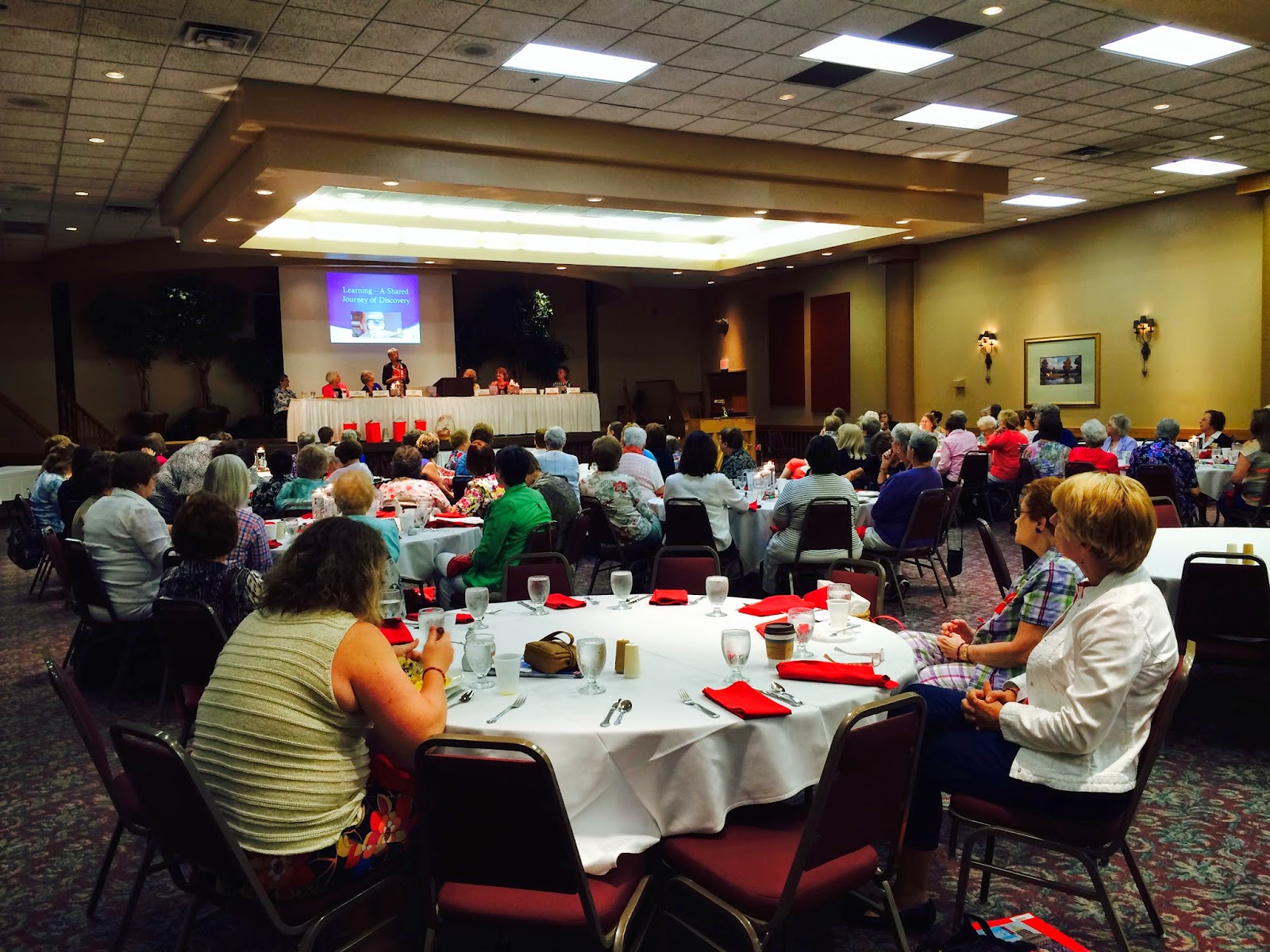
On Sunday, June 15, I served as the keynote for their inspirational brunch.  The topic of the speech:  Learning - A Shared Journey of Discovery.


Over 150 attended this event.  Until this weekend, I was not familiar with the DKGs but now I look forward to becoming a member.  Beverly Helms, Delta Kappa Gamma International President, announced she was paying my dues for the first year.  Now I just have to wait to see if they vote me into this group of passionate educators!  Check this organization out at:  https://www.dkg.org

Sunday, June 8, 2014

How Does One Become Iowa Teacher of the Year?

The 2014 State Teachers of the Year in the East Room at the White House where I wore a pink suit in honor of breast cancer awareness for my mother (a survivor), my friend Peggy Claus, and my dear teacher friend Margie McDermott


I attended a two-day workshop this week on Professional Learning Communities.  At one point in the group discussion, the presenter mentioned that in her school while serving as principal, she moved away from individual awards to group recognition in order to promote teamwork and collaboration.  She then mentioned that many states have a Teacher of the Year program where one teacher is chosen to serve in this role.  A person in the crowd asked what TOY meant and how was this person chosen.  I did not speak up in the room but did go to the person later to explain the process in Iowa and will now explain it here. 

In Iowa, the Iowa Department of Education sends out an explanation and nomination papers to every superintendent in the spring.  They are encouraged to nominate a person for this award. Nomination forms are also linked on the Iowa Department of Education website so any teacher, parent, or student can nominate a person to become Iowa Teacher of the Year.  In my case, a colleague nominated me for this honor.  Once a nomination is given, the person nominated receives an application to complete.  This application and questions are modeled after those questions each state Teacher of the Year must complete for the National TOY program.  Completing the application is a reflective process, much like the process one must go through when seeking National Board Certification.  You analyze your teaching, best instructional practices, and explain your vision for the future of education.  Along with your reflections, you present three letters from various people who believe you should be the Iowa Teacher of the Year.  In my case, letters were given from my superintendent, my mentee/co-worker, and a past student majoring in education.

Once you have submitted your application, the applications are evaluated by a committee and six finalists are invited for an interview in DesMoines.  You are invited to give a presentation followed by an intense interview with more than 12 present, representing educational organizations from around the state of Iowa.  The person chosen as Iowa Teacher of the Year is considered to be the Ambassador of Education for our state.  As the Iowa TOY, I help to lead the Outstanding Iowa Teachers Advisory Committee to have teachers' voices heard.  I also serve on the Educator Quality Bureau at the Iowa Department of Education.  It is an honor I will always hold dear.

When going through National Board Certification ten years ago, I was consumed by the process.  When I consider both Master's programs I have completed, none compare to the NBC process for reflection and analysis.  I became a reflective practitioner and when the NBC process was over, and I became National Board Certified,  I continued to be reflective in all of my instruction.  Throughout my years in education, I have  been committed to continuous learning.  I firmly believe that we only improve through goal-setting, risk-taking, and a commitment to the process of improvement.  Have a met all of my goals?  Not yet which keeps me fresh and moving forward.  Have I always been successful in risk-taking?  No, but I have learned more from my mistakes than from my successes.  Am I committed to improvement?  You bet.  It's this commitment that keeps me seeking new and different ways to motivate and inspire students.  All of these beliefs have now led me to hold the title of Iowa Ambassador to Education.

As I move into my second half of the year as the 2014 Iowa Teacher of the Year, I look forward to visiting school districts and education programs across the state.  I enter a sabbatical from the classroom this next school year.  It will be very different not preparing a classroom and writing units, but I look forward to meeting educators, sharing their ideas with others, and experiencing firsthand the outstanding work that Iowa teachers and administrators are performing across our great state.  I hope districts and college education programs will invite me for visits.  I am more than willing to present to groups about a profession I hold dear that is making a difference in the lives of today's youth.